
Built by a judgment creditor who needed a better way.
DueByLaw began as California Judgment Calculator, which grew from one self-represented creditor’s need for a practical, affordable way to understand what was owed and preserve the judgment’s history over time.
Built From Real-World Frustration
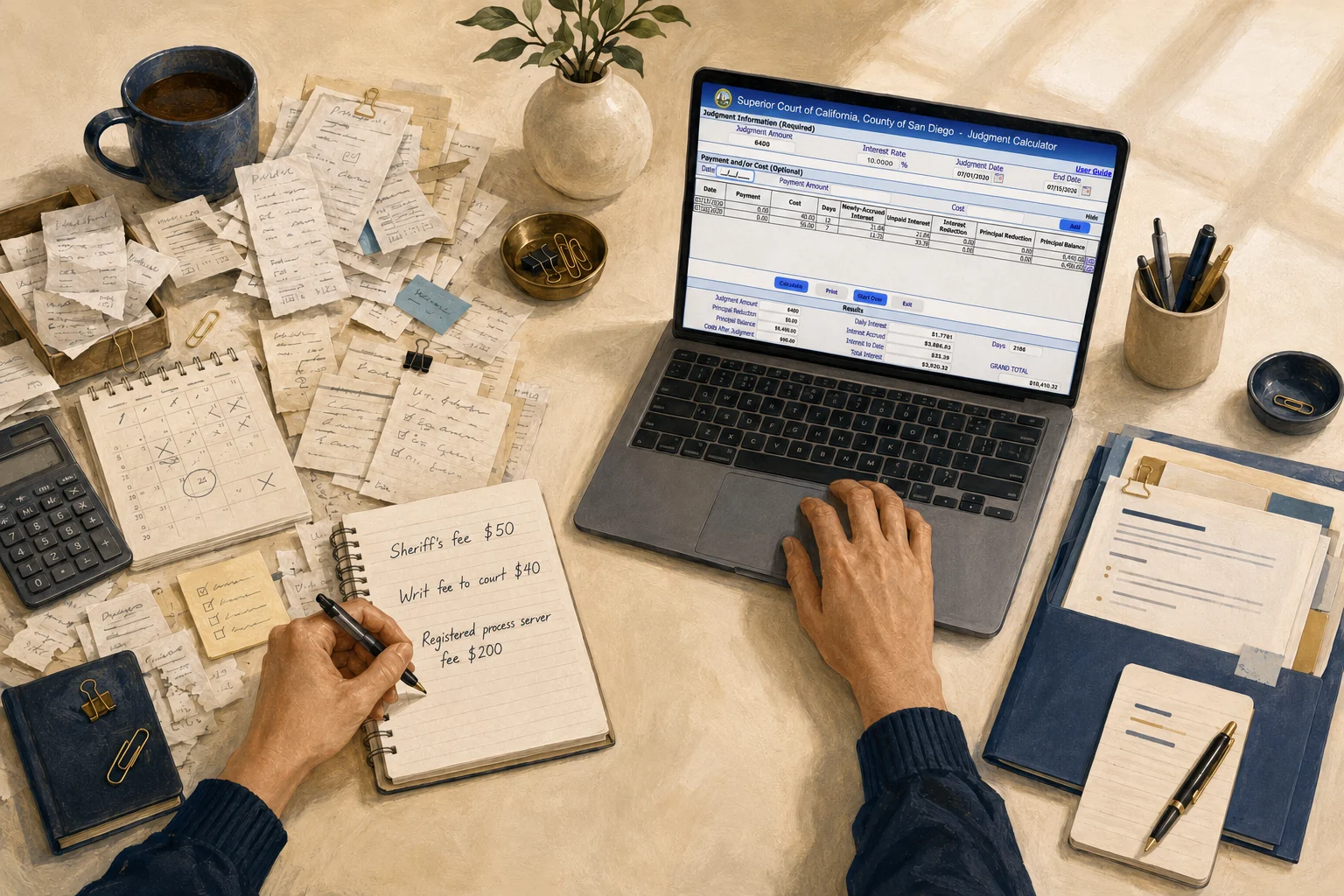
California Judgment Calculator grew out of my own experience as a self-represented litigant who became a judgment creditor. Winning the case was only the beginning. Once collection started, I faced a judgment debtor who challenged costs and resisted enforcement at nearly every step.
That made accurate recordkeeping essential. Every cost needed a date, supporting documentation, and a legal basis. Payments and credits had to be recorded correctly. Whenever I needed an updated post-judgment calculation, I found myself re-entering the same judgment information, costs, payments, and credits into the San Diego Superior Court’s free calculator or another basic online calculator.
Those tools were extremely helpful with the math, but they were not designed to preserve an ongoing judgment history, organize receipts and supporting documents, or spare me from starting over the next time.
There had to be a more practical way.
The Gap in Existing Tools
Basic calculators solve the immediate arithmetic problem, but they generally do not preserve the ongoing history. More advanced judgment-management systems are usually built for law firms and professional enforcement businesses. For an individual managing a judgment, they can be too expensive, too complicated, or simply more software than the job requires.
The missing middle was a straightforward tool that could calculate the balance for free, then preserve the dates, costs, payments, credits, receipts, and references when continuing to manage the judgment.
Why California Judgment Calculator Exists
I built California Judgment Calculator to bridge that gap: a practical, affordable way for self-represented judgment creditors to calculate what is owed, maintain the history over time, and feel more confident about managing the judgment they worked so hard to obtain.
Keeping the Judgment Ledger current means less reconstruction when the next payoff calculation, enforcement step, or other post-judgment task arrives. You may even go from dreading the paperwork to enjoying the process. That may be overly optimistic, but stranger things have happened.
Judgment Ledger can also reuse the history you have already maintained across guided post-judgment workflows, without requiring you to rebuild the same information manually.
Who It Is For — and What It Does Not Do
The tool was designed first for self-represented California judgment creditors. It may also assist process servers, legal-support providers, collection professionals, and others who work with California judgments.
California Judgment Calculator is an arithmetic, recordkeeping, and organizational tool. It does not provide legal advice or determine the proper interest rate. It does not decide whether a particular cost is legally recoverable, which filing or procedural step is appropriate, who legally must be served, or whether a service method is legally permitted or sufficient. It does not file, serve, or perform other real-world legal tasks.
Users remain responsible for reviewing calculations, reports, other outputs, supporting documentation, and applicable legal requirements before relying on or using them.
Ready to calculate what is owed?
Use the free calculator now, or start a free trial when you’re ready to save and manage your calculation as a Judgment Ledger. Your trial begins when your account is created and ends at 11:59 PM Pacific on Day 7. No credit card is required, and the trial does not automatically convert to a paid subscription.